F&B teams rarely lose money on the first delivery of custom ceramic dinnerware. The cost appears in year two, when breakage climbs and a reorder lands a shade off the approved sample.
This article is for hotel groups, restaurant chains, caterers and importers who buy custom ceramic dinnerware by the container: the spec sheet, the durability signals that predict service life, decoration that survives commercial dishwashing, and the reorder standard to write into an oem ceramic supplier contract.
Hospitality Volume Is Reshaping Bulk Supply
Fortune Business Insights values the global ceramic tableware market at USD 13.43 billion in 2025 and USD 14.38 billion in 2026, reaching USD 24.91 billion by 2034 at a 7.11% compound annual growth rate (updated August 24, 2026). The USDA Foreign Agricultural Service counts 214,000 tons of ceramic tableware entering the United States yearly, and a ceramic tableware manufacturer new to European buyers feels that pressure late.
market.us sizes the commercial tableware market at USD 9.2 billion in 2024, heading for USD 16.6 billion by 2034 at 6.1% CAGR, with dinnerware holding 59.2%. Europe takes the largest regional share at 34.8%, worth USD 3.1 billion, which is why European hotel groups press hardest on glaze lot matching.
Any ceramic tableware manufacturer can quote a plate; few can repeat it in 2029. Choosing an oem ceramic supplier means choosing a production habit, and wholesale ceramic dinnerware buyers pay for it long before a sample arrives.
Let the Menu Set the Specification
Kitchen equipment gets specified from the menu outward; tableware too often from a mood board inward. Sauced plates need a coupe profile that holds liquid, a noodle programme needs a deep bowl with a stable footring, and a buffet needs pieces that stack without grinding. Write the dish list first, assign a vessel to every dish, then ask a porcelain dinnerware factory what it can hold in tolerance. The gap between a catalogue photo and a custom ceramic dinnerware programme is measured in millimetres.
Sizing mistakes cost more than design mistakes. A plate that reads generous on a showroom table looks mean under a large protein, and an oversized bowl raises portion cost at every service. Ask for samples from the production mould. Buyers who keep wholesale ceramic dinnerware samples in the kitchen catch sizing errors early, and our custom ceramic dinnerware range lists the vessel types hospitality buyers request most.
Durability Signals That Predict Service Life
Glaze colour wins the first order; body specification decides service life.
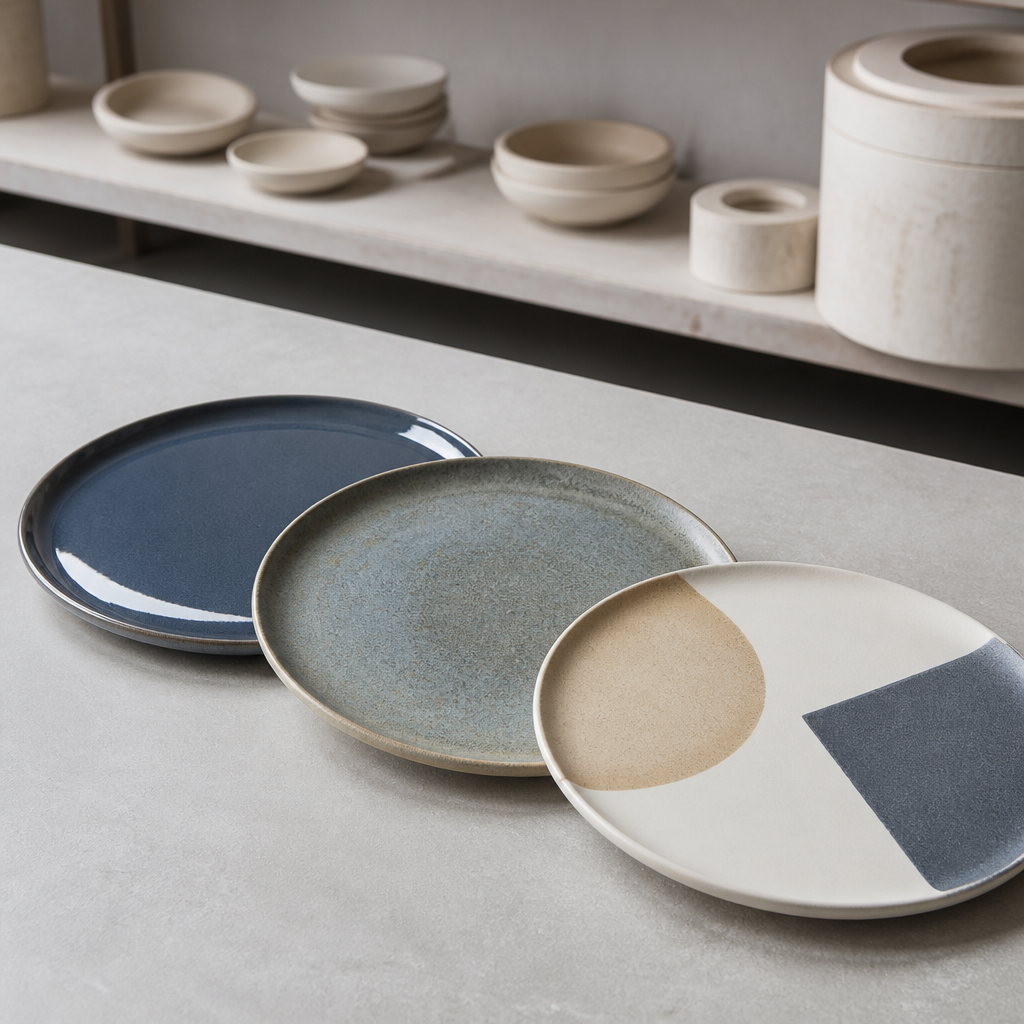
Ask for absorption data and chip-resistance results before approving a custom ceramic dinnerware sample, not the word durable. Approach a ceramic tableware manufacturer for three years of claim data and you learn about kiln discipline, not marketing. Reactive glaze work such as the hotel pasta plate in Bangkok brown shows how a porcelain dinnerware factory balances surface character against a rim that takes daily service, the line between wholesale ceramic dinnerware built for service and retail stock.
Decoration: Glaze, Decal and Logo
Reactive glaze makes colour variation part of the design, so approval depends on a signed sample. In-glaze and underglaze printing fuses graphics into the glaze, the most wash-resistant option for crests and wordmarks. On-glaze decal gives the brightest output and the shortest life.
An oem ceramic supplier should state decoration durability in dishwasher cycles and confirm the graphic survives commercial detergents and hot drying. Colour control is the harder test, because only a ceramic tableware manufacturer that manages glaze by batch record can promise a custom ceramic dinnerware reorder eighteen months later lands inside tolerance.
Food Safety and Certification Checks
Firing temperature protects the body, not the surface chemistry. Glaze and decoration determine what can migrate into food, and the evidence required differs by market: LFGB and (EC) No 1935/2004 for the European Union, FDA requirements for the United States, California Proposition 65 for the West Coast. Hold a lead and cadmium migration report issued against the production batch, a document every wholesale ceramic dinnerware buyer should file beside the spec.
Chaozhou Qianyue Ceramics, founded in 1984 and running two factories with more than 12 production lines, holds BSCI, LFGB, (EC) No 1935/2004, ISO 9001 and ISO 45001 certification, and produces lead-free, cadmium-free ware safe for microwave and dishwasher use. For a ceramic tableware manufacturer bidding on hotel supply, that paperwork is the entry ticket, not the pitch. Ask for certificates before price: an oem ceramic supplier that hesitates on documentation will hesitate on a reorder, and a porcelain dinnerware factory filing test reports by customer is easier to audit.
Packaging and Freight Planning
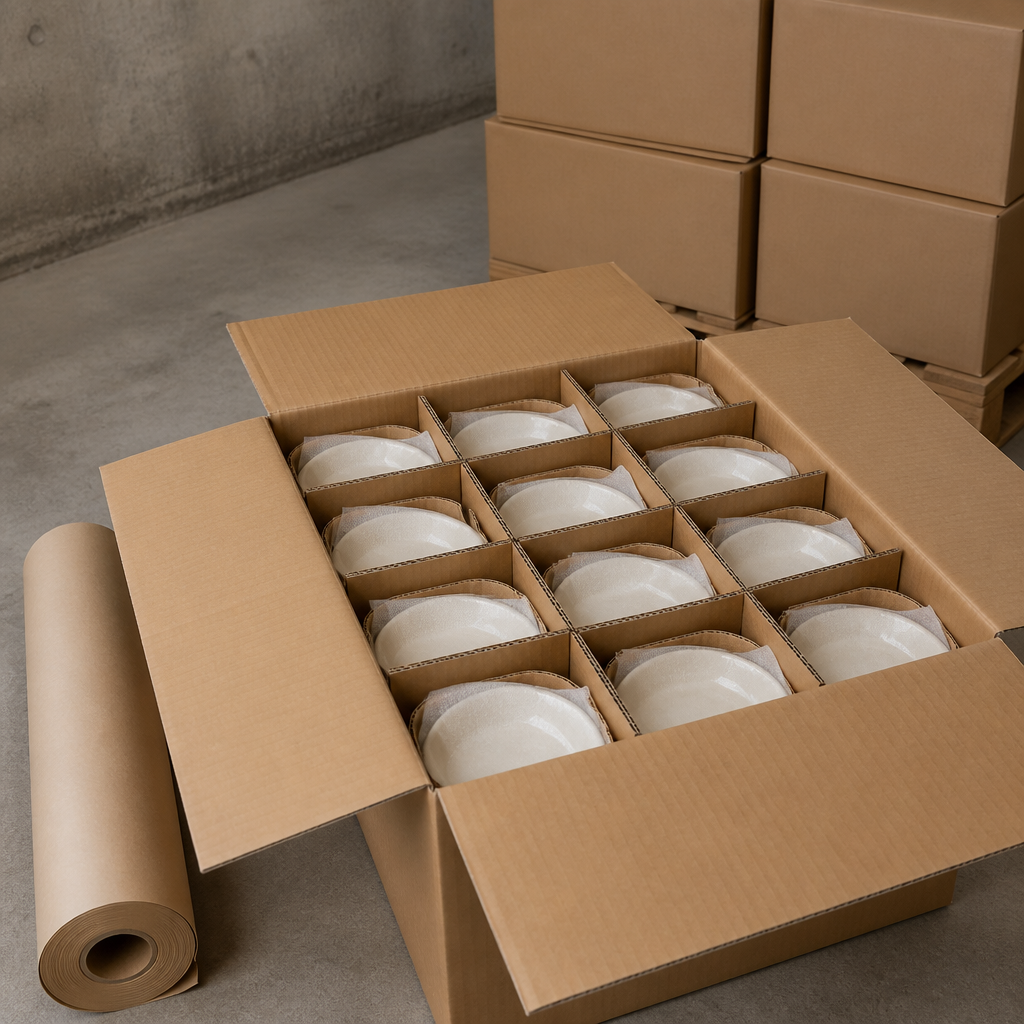
Transit breakage is decided at the packing line. Ask a ceramic tableware manufacturer how each piece is wrapped, whether corrugated dividers separate every item, and what carton compression strength the spec targets. Full dividers cost more per carton and pay for themselves on a container of wholesale ceramic dinnerware. An oem ceramic supplier with a written packing standard shows you the carton instead of describing it.
Mixed-SKU containers, pallet configuration and unpacking order all shape first-year damage. Order wholesale ceramic dinnerware across categories and request a damage-rate figure from comparable hotel shipments. Importers replacing a damaged pallet mid-season rarely receive a matching glaze lot, so a custom ceramic dinnerware programme that budgets for better packing spends less than one budgeting for claims.
The Cost of Switching Suppliers Mid-Programme
Most custom ceramic dinnerware programmes are five to eight year decisions quoted as one-off orders. The classic failure: a strong first delivery, then a slow drift in body weight, glaze tone and rim thickness across reorders.
Test the reorder discipline of any oem ceramic supplier before committing. Ask how approved samples are archived, how long they are kept, and who signs off a colour match. A porcelain dinnerware factory holding sealed approval samples for years behaves differently from a trader reordering from whichever kiln has capacity. Lock the specification in writing, with the approved sample governing every later custom ceramic dinnerware shipment, and make the porcelain dinnerware factory name the archive in the contract.
What Belongs in the Spec Sheet
Write the brief as a document the factory signs.
A ceramic tableware manufacturer can only guarantee what appears in the brief, and a porcelain dinnerware factory can only hold a written tolerance. Spell out the tolerances behind every line of wholesale ceramic dinnerware you intend to reorder; any ceramic tableware manufacturer or oem ceramic supplier will treat undocumented expectations as outside scope.
FAQ
How do we start a custom ceramic dinnerware programme? Send the dish list, target quantities and destination market. Request samples from the production mould, approve a sealed reference piece, then order against it.
Can one supplier cover plates and drinkware? Qianyue produces dinnerware, drinkware, bakeware, glassware and serving sets, which cuts the number of wholesale ceramic dinnerware shipments and keeps decoration consistent.
What should we check on the first container? Verify weight and diameter against the approved sample, compare glaze tone under identical lighting, and photograph the unboxing. Then ask whether the same wholesale ceramic dinnerware line runs on the same kiln next season. A ceramic tableware manufacturer that answers directly is worth a longer contract; a porcelain dinnerware factory that cannot is worth a second sample round.
Getting a Specification Reviewed
Send the dish list and destination market to [email protected] or call +86-13534638099. The team reviews the brief, proposes vessel sizes and decoration methods, and ships samples before any custom ceramic dinnerware order is confirmed. The range sits at https://www.qyceramics.com/.
Chaozhou Qianyue Ceramics has produced custom ceramic dinnerware since 1984 for buyers in Europe, North America, South America, Oceania, Asia and the Middle East. The company works as a ceramic tableware manufacturer, an oem ceramic supplier and a porcelain dinnerware factory inside one production group. Two factories, more than 12 production lines and a documented export packing standard sit behind every wholesale ceramic dinnerware order. Buyers who need an oem ceramic supplier and a porcelain dinnerware factory working from the same approved sample will find that in place.
 EN
EN