Cartons decide whether a wholesale ceramic tableware order lands as stock or as a claim, and since 12 August 2026 also whether it sells in Europe at all. Regulation (EU) 2025/40 applies from that date, with PFAS limits live for food-contact packaging and recyclability on a 2030 clock (SGS, May 2026; CIRS, April 2026). A market worth USD 21.4 billion in 2025, forecast at USD 30.88 billion by 2031 (Deep Market Insights, June 2026), moves through pulp and pallets. A ceramic tableware manufacturer now proves its ceramic tableware packaging rather than describing it, and a custom ceramic tableware supplier quoting from a tested pack is the one worth shortlisting.
Ceramic takes compression well and bending badly. A plate loaded flat is close to unbreakable; struck at an angle on an unsupported rim it chips, because the impact has nowhere to go. Wholesale ceramic tableware shipped as one shrink-wrapped slab builds a lever, driving energy from the bottom carton into the top rim, and a wholesale ceramic tableware reorder repeats the fault. Pulp trays interrupt that path, and a ceramic tableware manufacturer quoting only a box size has not started. Ceramic tableware packaging is a location problem before it is a thickness problem, so a custom ceramic tableware supplier measures the cavity before quoting.
Regulation (EU) 2025/40 replaced a directive with a directly applicable regulation, in force since February 2025 and applying from 12 August 2026 (SGS, May 2026). Two clauses touch a ceramic tableware manufacturer shipping into the union: food-contact packaging may not carry PFAS at or above 25 ppb for any targeted compound, plus heavy metal ceilings (Article 5(5); CIRS, April 2026), and all packaging must be designed for recycling by 2030. A custom ceramic tableware supplier that re-specified early hands over documents, and one that did not leaves the ceramic tableware packaging risk with the buyer of wholesale ceramic tableware.
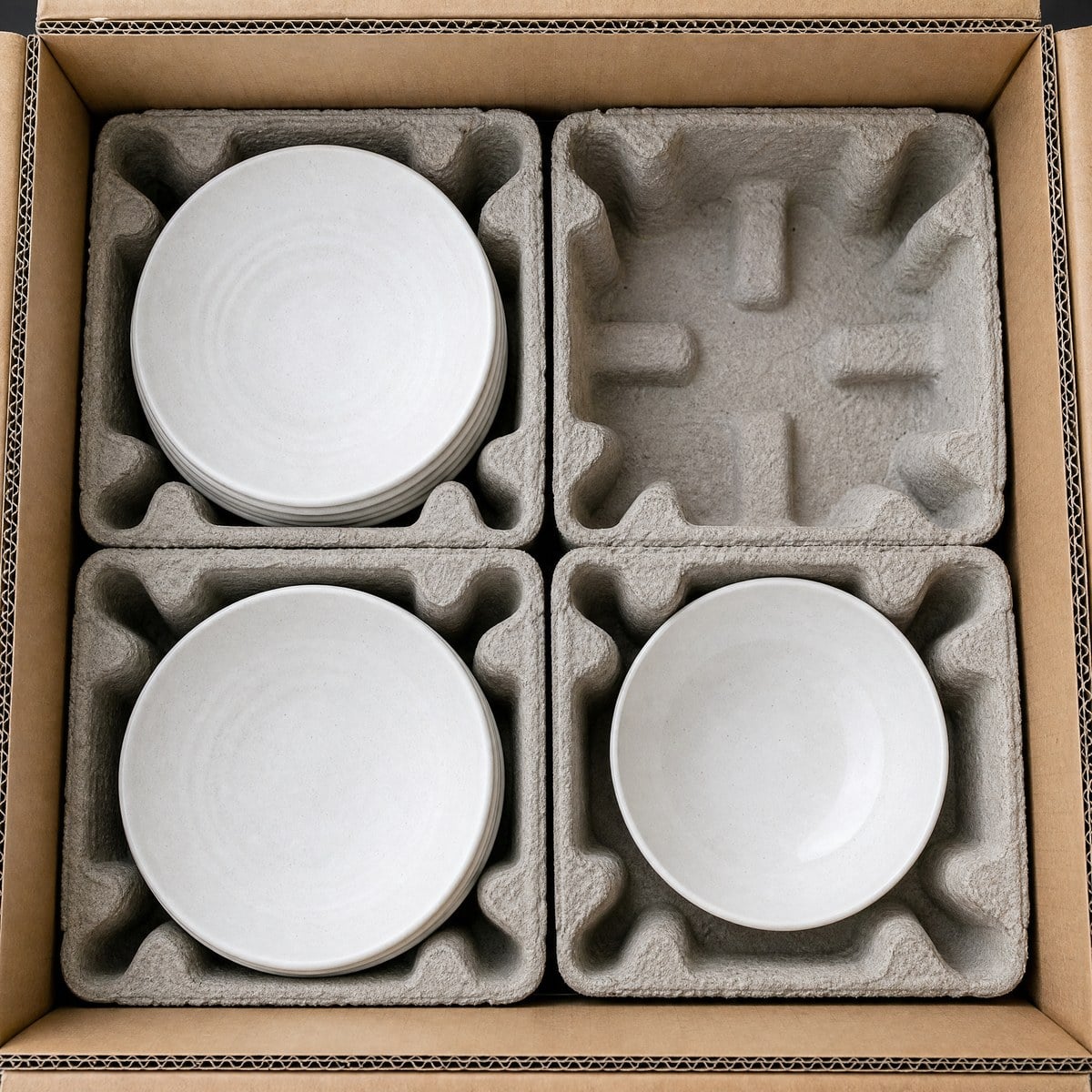
ISTA 3A simulates parcel delivery for packages up to 70 kg, running a carton through conditioning, free drops, random vibration and impacts before inspection (ista.org). Passing it is voluntary, which is why the report separates a ceramic tableware manufacturer from a trading office. Read the date, lab and packed weight: a 12 kg report says nothing about a 24 kg case. A ceramic tableware manufacturer serious about export tests the retail carton inside the master carton, the pair a courier throws. A custom ceramic tableware supplier publishing that result quotes from evidence, and wholesale ceramic tableware priced on a custom ceramic tableware supplier's promise fails at the port.
Dividers work when they touch the strongest part of a piece. A foot ring takes load; rim and glaze take damage. Moulded pulp trays that locate each piece by the foot, with a gap between faces, beat bubble film, and a custom ceramic tableware supplier should explain the cavity's shape. Mugs break at the handle join, so the cavity braces the handle. A wholesale ceramic tableware buyer lifts one piece from a pre-production pack and asks what holds it, as a ceramic tableware manufacturer should know, and a sample that shifts shifts at sea, whatever the ceramic tableware packaging drawing says.
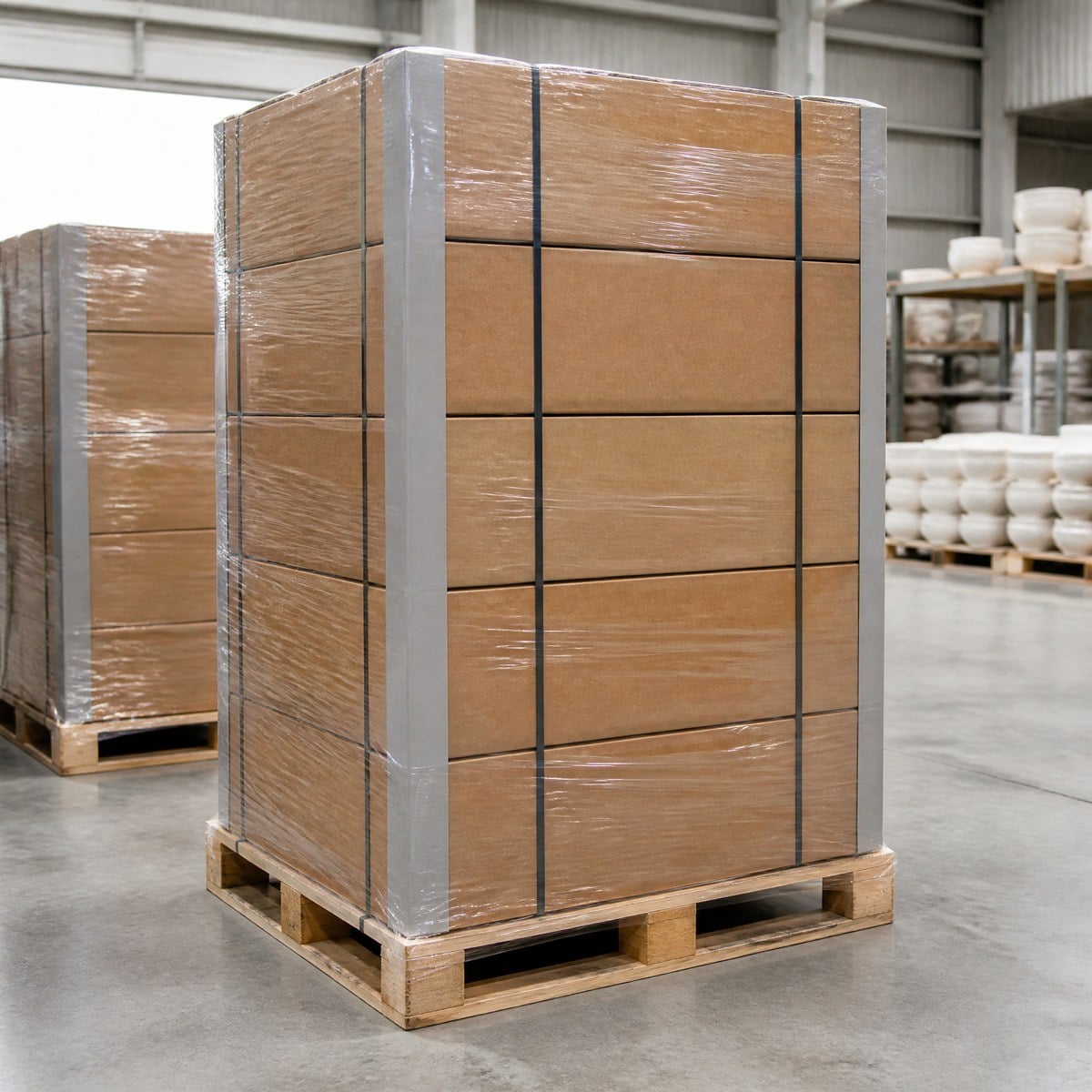
Corrugated is quoted by flute and strength, and buyers rarely see either number. A double-wall BC-flute carton at a stated edge crush test survives a stacked container; a single-wall copy may not, and an oem ceramic dinnerware load is heavier than it looks. Board loses strength as moisture climbs, so a carton that tests well dry can fail after three weeks at sea. Ask a custom ceramic tableware supplier for board construction, edge crush and burst, then for the load the carton holds when stacked. A ceramic tableware manufacturer quoting a grade without those figures quotes a look, and ceramic tableware packaging follows from those figures or from guesswork. An oem ceramic dinnerware order on an unrated carton fails as crushed corners.
Print outside a carton is regulated less than buyers assume; print migrating onto food contact is another question. Mineral oil hydrocarbons travel from recycled fibre and offset inks, and PFAS limits push buyers toward water-based inks and unprinted inner faces. One rule covers most of it: nothing printed, laminated or adhesive sits against glaze. Tissue, unprinted pulp or a plain poly bag does that work, and a ceramic tableware packaging spec should name which. Tape matters too: hot-melt adhesive on a recycled liner releases in a cold container. Ask a custom ceramic tableware supplier which liner it uses, since an oem ceramic dinnerware line inherits the choice, and a ceramic tableware manufacturer that cannot answer has not read its own board spec, which is how ceramic tableware packaging fails quietly.
A pallet is a ceramic tableware packaging decision, not a logistics detail. Cartons sized to a 1200 by 1000 mm footprint fill a container with no air; one drawn around its own proportions leaves gaps a forklift turns into racking damage. Corner protectors and two straps hold a load film cannot, and film under tension crushes a tall stack's top layer. A ceramic tableware packaging drawing should match carton height to the pallet plan, not to piece count. Wholesale ceramic tableware then loses its commonest damage source, the leaning pallet re-stacked by hand, which a ceramic tableware manufacturer publishing footprint, layer count and stack height removes.
One ceramic tableware packaging page covers pieces per carton, location method, board construction with edge crush and burst, packed weight, pallet footprint and stack height, test standard, printing, liner and marking. A custom ceramic tableware supplier quotes from it in one pass; without it an oem ceramic dinnerware order is packed to whatever the last buyer accepted. A wholesale ceramic tableware buyer should keep that page and photograph the sample pack, because a description of a pulp tray rarely matches the tray that arrives.
Three ceramic tableware packaging failures recur. Plates wrapped face to face with no divider, so glaze rubs and arrives scuffed rather than broken. Cartons filled to the top with no headspace, so the first drop lands on the flap seam. Pallets stacked past the height the board was rated for, failing a construction designed for four layers. None appears in a factory photograph; all three appear in the first claim. A ceramic tableware manufacturer serving Europe, North America, South America, Oceania, Asia and the Middle East has usually corrected them, so ask that ceramic tableware manufacturer for the revised drawing, since a wholesale ceramic tableware order approved on a photograph approves packaging nobody tested.
Which test proves a carton is safe for export?
ISTA 3A covers parcel networks up to 70 kg and is the report any ceramic tableware manufacturer should be able to produce, as ceramic tableware packaging evidence most buyers accept. Pair it with compression and humidity data for ocean freight, where a stack loads a carton for weeks.
Can recycled pulp dividers satisfy the rules now in force?
Usually. Single-material moulded pulp is easier to defend than a laminate and free of the plastic windows a review flags. A custom ceramic tableware supplier can confirm no PFAS treatment, because the limits are concentration based.
How do I judge breakage risk before a full order?
Order a packed sample, drop it from the height your courier uses, open it, inspect rims. Then read the packed weight on the test report, which separates ceramic tableware packaging from a promise.
Chaozhou Qianyue Ceramics has worked as a ceramic tableware manufacturer since 1984, running two factories that produce around eight million sets a year across more than a dozen lines, with over two hundred staff. BSCI, LFGB, (EC) No 1935/2004, ISO 9001 and ISO 45001 sit on file, glazes carry no lead or cadmium, and pieces are rated for microwave and dishwasher use. Export cartons follow a strong standard board specification rather than whatever a forwarder offers. Send pallet footprint, channel and target market to [email protected] or call +86-13534638099, and browse the dinnerware range first. Packing is the final quality control step, and a custom ceramic tableware supplier that tests the pack protects the company profile record, which rests on shipments that arrive whole, so a wholesale ceramic tableware buyer should ask to see the test pack.
 EN