A cafe sells with its eyes before anyone tastes anything, and the counter is where that happens. The global pastries market was valued at USD 68.48 billion in 2025 and is projected to reach USD 92.85 billion by 2034 (marketdataforecast, July 2026), while bakery products overall sit near USD 650 billion in 2026 (Mordor Intelligence, April 2026). That spending lands on counters where a ceramic serving set manufacturer has roughly two seconds to make a plate look worth its price. This guide is for cafe owners, patisserie buyers and hotel F&B teams choosing a custom cake stand wholesale programme, assuming a ceramic serving platter supplier that measures before quoting, not after the first complaint.
The counter and the kitchen want different things
Dinnerware is bought for durability under a fork. Display ware is bought for what it does to a price tag. A ceramic serving set manufacturer selling to cafes is answering a merchandising brief: how the piece reads at forty centimetres, how it stacks behind the counter, and whether a server can carry it through a doorway. The kitchen wants weight that survives a commercial cycle; the counter wants a profile that photographs well. Where those demands meet, a custom cake stand wholesale order either works or becomes shelf stock, and no custom ceramics supplier can rescue a piece chosen for the wrong counter.
Height is a sales decision, not a styling one
A cake stand earns its space by lifting product into the eye line. A low plate puts pastries at hip height, where foot traffic reads them as discounted. A raised stand puts the same tart at chest height, inside the natural scan. Dome clearance and tier spacing decide how much can be shown before the silhouette turns cluttered. That is why a ceramic serving platter supplier quoting a stand asks for counter height and pastry dimensions, not just the diameter, and why an oem ceramic supplier that quotes blind tends to lose the reorder.
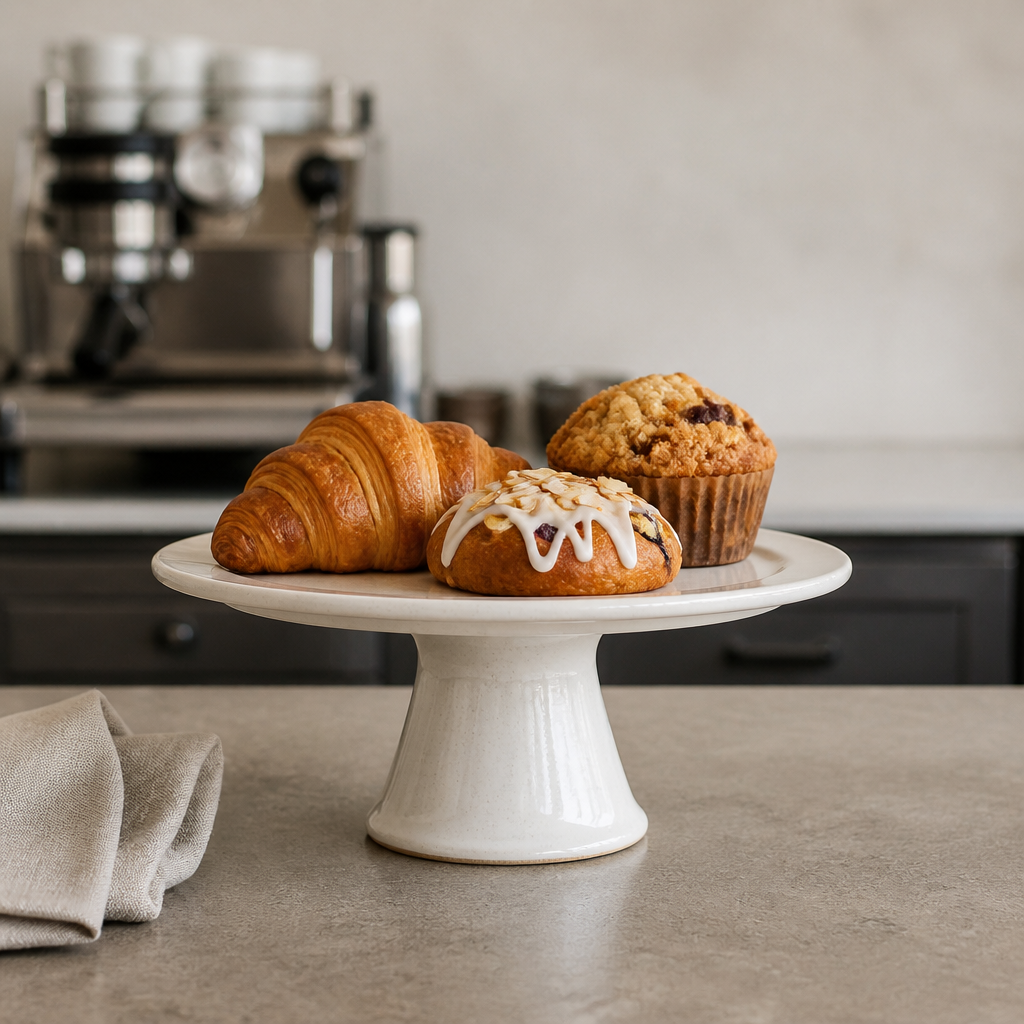
The pedestal is a structural problem
Pedestals fail at the joint, not at the plate. Torque from a loaded top tier transfers into the stem whenever a guest leans or a server lifts the stand by its edge. Foot diameter must widen with height, and the stem must be solid, not a sleeve over a hollow body. Ask a ceramic serving set manufacturer for a tipping angle rather than a load figure alone, since a stand holding nine kilos on a narrow foot is still a hazard. A custom cake stand wholesale brief without a foot dimension is incomplete, and a ceramic serving platter supplier that will not publish one is quoting a shape, not a product.
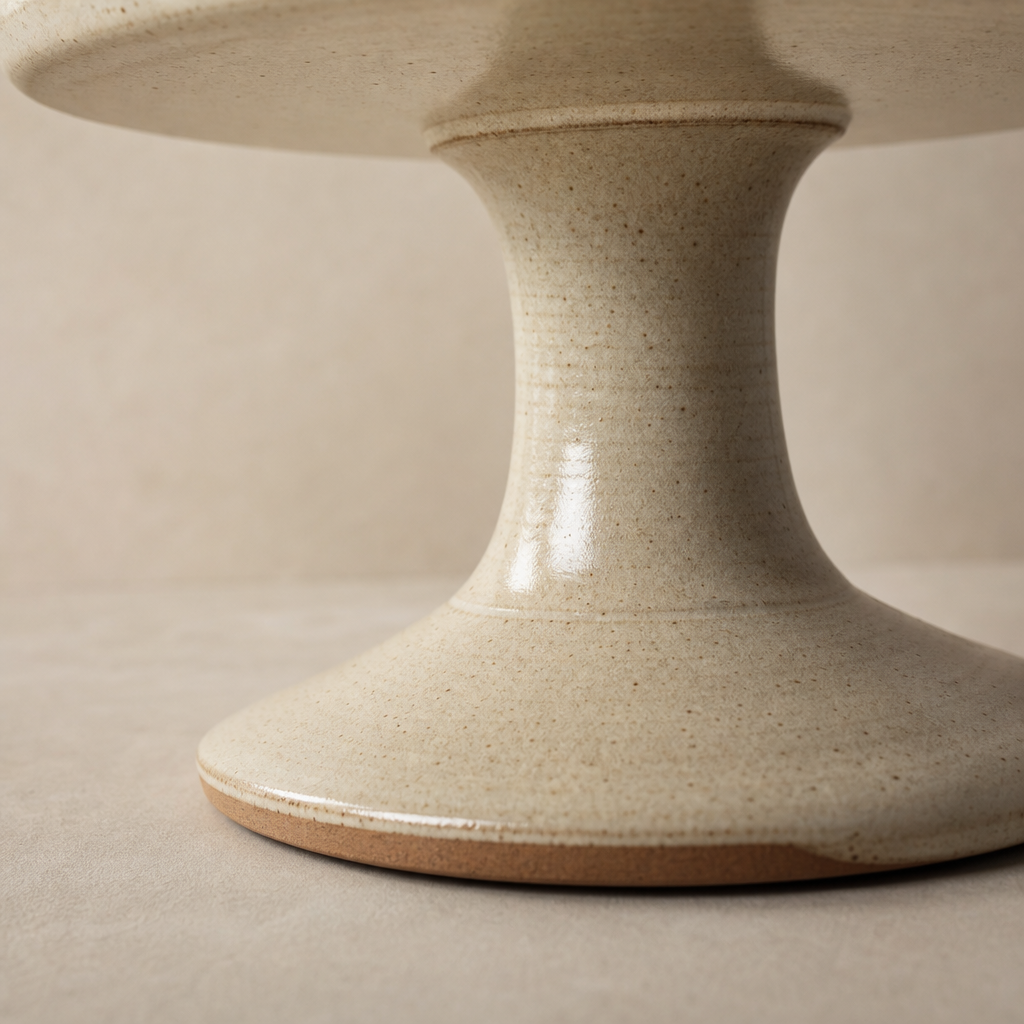
The exposed edge takes the damage
Cafes chip display ware at the rim: every plate is stacked, scraped and restacked dozens of times a day. Commercial dishwashing adds thermal cycling, which a custom cake stand wholesale buyer rarely models. A ceramic serving platter supplier should specify rim thickness and a chip standard, then test the packed unit rather than the approved sample. Glaze is the second factor: an under-fired glaze on hot, acidic menus stains faster than most kitchens expect. Ask the oem ceramic supplier for a stain result before a colourway is approved, then ask a custom ceramics supplier to repeat that test on the production run.
Colour stories and the mix-and-match trap
A serving range reads as a range only when glazes belong together. Reactive and speckled finishes shift between kiln loads, so a custom ceramics supplier providing two shapes months apart can deliver two tones. Order both from one firing, a rule an oem ceramic supplier may not volunteer. A matte exterior with a gloss interior costs real money: two glaze applications and a second inspection. Decide whether the range must match exactly or sit together loosely, since a ceramic serving set manufacturer prices those briefs very differently, and a ceramic serving platter supplier should quote both options side by side.
Size grading for the pastry case
Three diameters cover most pastry counters: small for tarts, mid for sharing portions, large for celebration cakes. Grading in even steps lets a custom cake stand wholesale buyer reorder the missing size without breaking the family. Height should scale with diameter, or the large piece reads unstable even when it is not, a point a custom cake stand wholesale supplier should raise. A cake stand in the large size also needs a foot wide enough to survive a busy service, which is where a custom cake stand wholesale quote usually changes, and where a ceramic serving set manufacturer either offers a fourth size or loses the top tier order.
Writing a serving range specification
Six lines carry most of the risk: diameter, height to the plate surface, foot diameter, stem construction, rim thickness and glaze finish against an approved sample. Add stain and chip tests, packed unit weight, and whether a dome or lid is included, which a ceramic serving platter supplier should confirm. Send counter height and pastry footprints, which decide display logic a ceramic serving set manufacturer cannot infer. A ceramic serving platter supplier can quote from that document in one pass, while an oem ceramic supplier reading a photo guesses at every dimension, and a custom ceramics supplier that asks three questions will beat one that asks none.
Packing wide, shallow pieces
Display ware breaks differently from dinnerware, a point a custom ceramics supplier should raise early. A wide shallow plate flexes, so a carton protecting stacks lets the rim strike a wall. Dividers should hold each piece by its foot rather than press on the face, a detail a custom ceramics supplier must specify. Stands need the stem braced separately, since a pedestal concentrates impact at its narrowest point. A ceramic serving set manufacturer testing the complete packed stand ships intact, and a custom cake stand wholesale buyer should make that test a condition of the order alongside the packed weight a ceramic serving platter supplier declares.
Where serving ranges go wrong in a cafe
Three failures recur in a ceramic serving set manufacturer review. The range is chosen from a catalogue rather than the counter, so nothing fits the case a ceramic serving platter supplier measured. The colourway is approved from a photo, then arrives warmer or cooler than the interior a custom ceramics supplier matched. The stand is bought without a spare, a habit a ceramic serving set manufacturer warns against. A custom ceramics supplier talking to an operator should raise all three before taking a specification, because a display piece that misses the counter comes back after the season, a cost an oem ceramic supplier never sees and a custom cake stand wholesale buyer always does.
Frequently asked questions
Can ceramic cake stands go in a commercial dishwasher?
The plate often can, the pedestal usually should not. Detergent and thermal cycling work on the stem joint. Wash the top by hand, and confirm with a ceramic serving platter supplier which components carry that rating, then ask a ceramic serving set manufacturer to print it on the carton.
How do I stop colour drift between reorders?
Fix the glaze to one approved sample, keep the batch reference, reorder both shapes together. A custom ceramics supplier storing fired references can match a tone a year later, while a ceramic serving set manufacturer that never fired your body has no baseline at all, unlike a custom cake stand wholesale line kept on file.
Is porcelain or stoneware better for cafe display?
Porcelain gives a finer edge and a whiter body, which suits patisserie. Stoneware takes thicker sections and heavier glazes, which suits rustic counters, and neither is stronger by default at the same wall thickness. Ask a custom cake stand wholesale supplier which body it quotes, then ask an oem ceramic supplier for absorption figures covering both, and most cafes end up specifying both bodies inside one range, which an oem ceramic supplier can quote as a single programme.
Get a quote
Chaozhou Qianyue Ceramics dates from 1984 and runs two plants whose combined output reaches eight million sets a year over a dozen or more lines, with a workforce above two hundred. BSCI, LFGB, (EC) No 1935/2004, ISO 9001 and ISO 45001 sit on file, and neither lead nor cadmium enters a glaze. Send counter measurements and pastry footprints to [email protected] or call +86-13534638099, then look through the serving set range and cake stand collection for shapes already in production. A ceramic serving set manufacturer quoting from drawings, an oem ceramic supplier naming its tests, and a ceramic serving platter supplier that checks foot width are what keep a custom cake stand wholesale order safe.
 EN