Bakeware is the part of the table that gets blamed for failure, and retailers feel it in returns rather than reviews. Grand View Research put the bakeware market at USD 4.3 billion in 2025 and projects USD 7.4 billion by 2033 at a 7.2% compound rate. That growth lands on a category where a ceramic bakeware manufacturer must satisfy two buyers at once: the retail buyer planning a shelf and the cook loading a hot oven. This guide is for custom baking dishes wholesale teams, for any ceramic baking dish supplier holding a claim across a season, and for the oem ceramic supplier behind the body.
Home baking left a mark on the aisle
Aisle space is the first constraint, because bakeware is bulky and a range that does not nest wastes the shelf it is given. In the United States alone, Research and Markets sized the bakeware market at USD 889.4 million in 2024 and projected 7.37% annual growth to 2033. A ceramic bakeware manufacturer earns the reorder by making the box claim easy to defend. Both a ceramic baking dish supplier and a custom baking dishes wholesale buyer judge it on the test file a custom ceramics supplier provides.
The shelf buys differently from the oven
Two people decide whether a range works, and never meet. The retail buyer looks at nesting, colour story, carton count and how the range photographs. The cook looks at whether the dish releases food, whether it stains, and whether it survives a hot oven meeting a cold worktop. A ceramic baking dish supplier must answer both briefs in one sample, so custom baking dishes wholesale talks start from the end use and a custom ceramics supplier gets briefed on cooking, not styling, by the ceramic bakeware manufacturer.
Four formats carry a range
The rectangular baking dish carries casserole and lasagne and is the volume line. The ramekin covers individual portions, souffle and cafe service, while the butter dish is a low-price impulse item that lifts basket value. The baguette baker and brownie pan give the range its point of difference. A ceramic bakeware manufacturer that tools all four as one family, sharing glaze and wall thickness, hands a retailer a range rather than four unrelated products, which is what every ceramic baking dish supplier should promise, and an oem ceramic supplier already running those moulds removes the tooling argument.
Heat is only half the problem
Oven heat is the easier test. The harder one is what sits on the food: fat, sugar, tomato and citrus held hot against the glaze for an hour. Under that load a glaze never designed for acidity can dull, craze or stain, since a porous body absorbs what the glaze lets through. A ceramic bakeware manufacturer quoting a line should show the glaze formulation and a stain result, a custom ceramics supplier should expect the same from its own body, and any ceramic baking dish supplier should refuse to quote without both, which is the standard an oem ceramic supplier is measured against.
The rim is where the range loses money
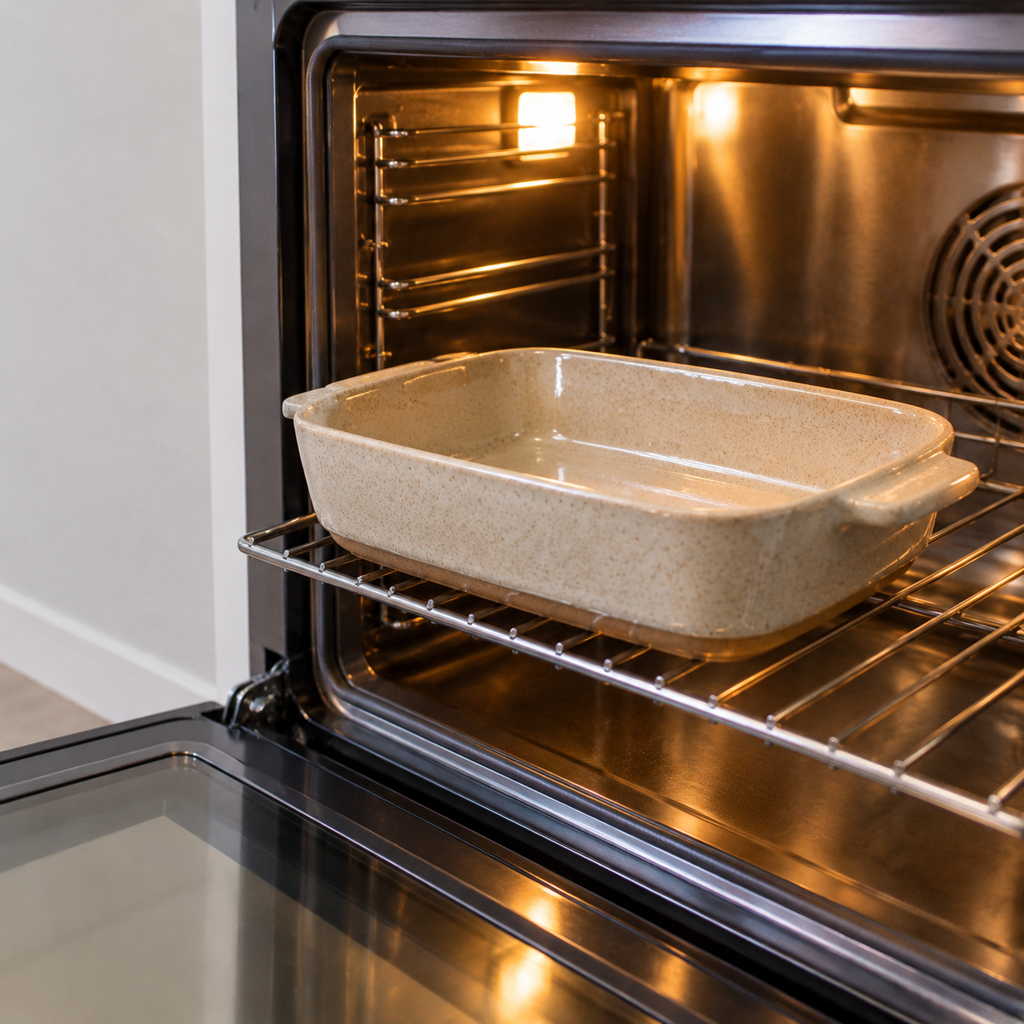
Bakeware chips at the rim, where the mass is thinnest and a dish gets gripped. Handles make it worse, concentrating load into a section that breaks first. A range built for the factory kiln may not survive a customer stacking two dishes in a cupboard. Specify rim thickness, handle radius and a drop standard, then test production pieces, because most custom baking dishes wholesale returns trace back to a rim designed for appearance, a ceramic baking dish supplier that never named its thickness, and a custom ceramics supplier that never asked.
Handles, weight and the oven-to-table claim
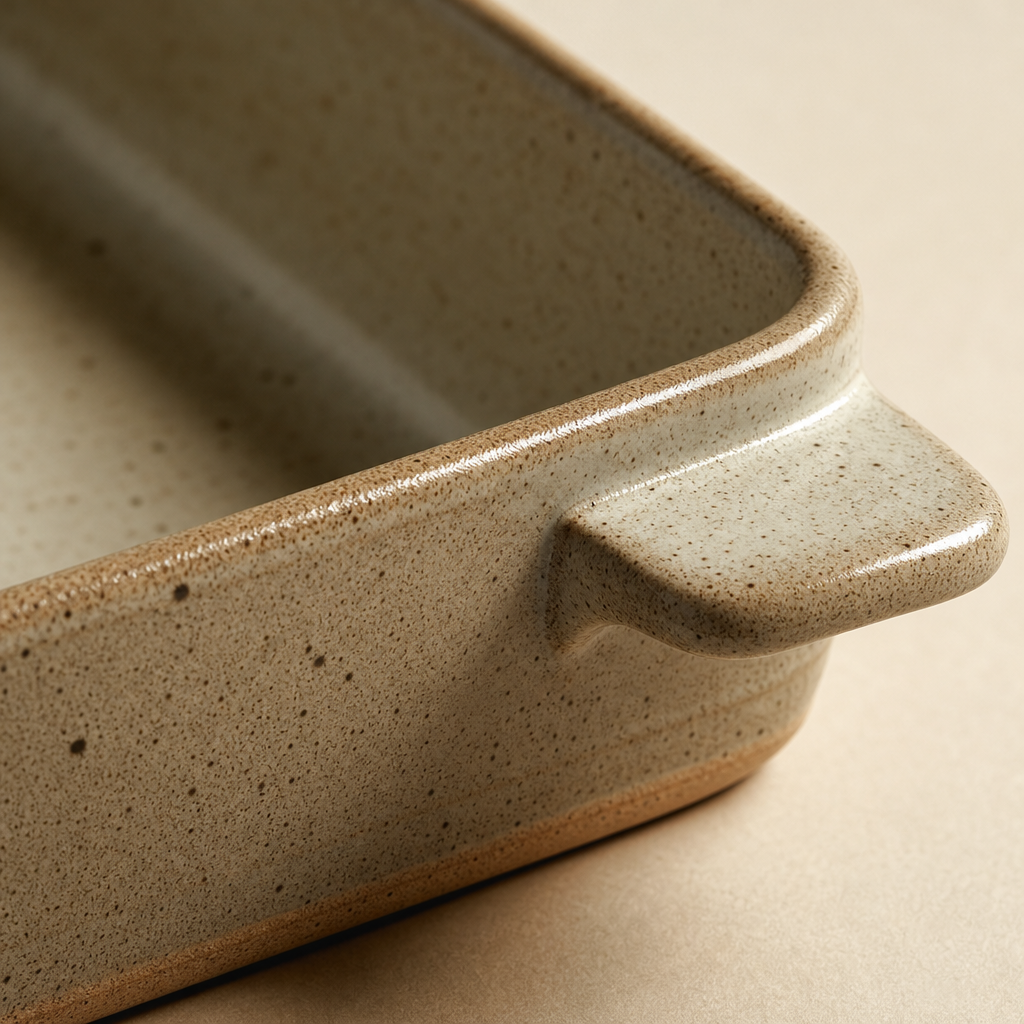
Oven-to-table is a merchandising claim with a physical cost. A dish heavy enough to feel substantial is heavy enough to burn a hand, so handles must be generous. Larger formats need a bigger footprint, which changes nesting and carton count. A ceramic bakeware manufacturer should publish the weight of every format, an oem ceramic supplier that names the number wins the value argument, and a custom ceramics supplier that cannot is quoting blind.
What oven-safe should mean in writing
A generic oven-safe claim covers nothing. The number that matters is the ceiling, which differs between stoneware and porcelain, so it belongs per body and per shape. Broiler use is separate, because radiant heat punishes the rim harder than ambient heat. Thermal shock is the third, and it is a usage question as much as a material one, since a frozen dish in a hot oven fails by design. A ceramic baking dish supplier should write all three down, a custom baking dishes wholesale buyer should refuse to list without them, and a ceramic bakeware manufacturer should sign the page, which is how a custom ceramics supplier earns the second order.
Writing the bakeware specification
A bakeware brief carries more lines than a plate brief: capacity at a stated fill line, internal length, width and depth, wall thickness at base and rim, handle geometry, body type and vitrification, glaze against an approved sample with a named stain and migration test, oven ceiling, broiler status, dishwasher claim and drop standard. Add the weight of the finished piece. Send that to a ceramic bakeware manufacturer and the quotation becomes a calculation. Send a photograph and the oem ceramic supplier guesses, which is where a custom baking dishes wholesale order drifts and a custom ceramics supplier gets blamed for it.
Packing a heavy, wide range
Bakeware breaks differently from dinnerware. A large flat dish is stiff, so impact travels straight to the rim, and a plate carton will not protect one wide piece. Corrugated cradles holding the rim clear of the wall do more than padding, and a master carton must be rated for its stack. A ceramic baking dish supplier that tests the packed unit, not the bare sample, ships intact, and a ceramic bakeware manufacturer and a custom baking dishes wholesale buyer should both insist on that test, which is the first question a custom ceramics supplier asks and the last an oem ceramic supplier wants.
How to compare two bakeware quotes
Two prices for the same dish differ in three places. One quote may amortise tooling and another not, one may price a single glaze and another three colourways, and one may include testing another leaves to the buyer. Ask for a line-by-line breakdown across tooling, body, glaze, testing and packing, then compare totals. A ceramic bakeware manufacturer that itemises is easier to hold to a reorder, and an oem ceramic supplier that will not itemise is telling you how the second order will go, which is what a ceramic baking dish supplier should be asked to prove and where a custom ceramics supplier parts company with a trading desk.
Frequently asked questions
Can ceramic bakeware go under a broiler?
Only if the body and glaze are rated for it, and most are not. Broiler heat is radiant and hits the exposed rim directly, so the ceiling is set per shape. Ask a ceramic bakeware manufacturer for the broiler status in writing, and expect a ceramic baking dish supplier to decline unless the piece was tested.
Why does a baking dish crack after a few months?
Usually thermal shock rather than a defect. A hot dish on a cold worktop, or a frozen one in a hot oven, puts the wall in tension faster than the body absorbs. A custom baking dishes wholesale range should carry care instructions naming both, because a ceramic bakeware manufacturer cannot design around misuse it never warned about.
Is stoneware better than porcelain for bakeware?
Stoneware is fired higher and is less porous, which suits slow even baking. Porcelain gives a whiter body and a finer finish. Neither is automatically better, because the decision follows the recipe, the price point and the colour needed. Ask the ceramic baking dish supplier which body it quotes and why, then ask an oem ceramic supplier for the absorption test on both.
Get a quote
Chaozhou Qianyue Ceramics has made ceramics since 1984 from two factories, with annual capacity of 8 million sets across 12 or more production lines and 200+ staff. The category covers baking dishes, ramekins, butter dishes and baguette bakers, and lists oven, microwave, dishwasher and sterilisation as functions. Certifications include BSCI, LFGB, (EC) No 1935/2004, ISO 9001 and ISO 45001, and every piece is lead-free and cadmium-free. Send your format, capacity and oven ceiling to [email protected] or call +86-13534638099, and browse the bakeware range and a real three-piece baking dish set. A ceramic bakeware manufacturer quoting from a fixed brief, a custom baking dishes wholesale forecast and a ceramic baking dish supplier that names its tests make the oem ceramic supplier decision easy.
 EN