A ceramic plate can pass every visual check and still fail at the border. Lead and cadmium migrate from the glaze, not the clay body, so the defect regulators test for is invisible without lead and cadmium testing. Ceramic tableware compliance is a documentary discipline, and it begins before the first sample is approved.
This article is for importers, retail buyers and brand owners rather than laboratory staff. It sets out the migration limits applied in the European Union and the United States, the method behind those numbers, what a declaration of compliance must contain, and the points where ceramic tableware compliance breaks.
Regulation Splits By Market, Not By Product
The same plate is regulated differently depending on where it sells. In the European Union, Regulation (EC) No 1935/2004 covers food contact materials, and ceramic articles carry specific rules on lead and cadmium release. In the United States, the FDA handles ceramicware under its compliance policy guide on pottery. A ceramic tableware manufacturer serving both markets needs two evidence sets - including lead and cadmium testing - and a porcelain dinnerware factory quoting one report for every destination describes a gap.
Treating compliance as a supplier promise meets trouble at the port, where nobody asks whether the ceramic tableware manufacturer believes its glaze is safe. The question is whether a report exists for the batch inside the container. Any ceramic tableware manufacturer can assert food safety; far fewer produce paperwork on request, which is why ceramic tableware compliance and lead and cadmium testing belong in supplier qualification. An oem ceramic supplier that separates certificates from batch results is easier to work with.
The EU Limits Buyers Should Know
Directive 84/500/EEC, as amended by 2005/31/EC, groups release limits by vessel category rather than product name. Non-fillable objects, and fillable items no deeper than 25 mm, are capped at 0.8 mg/dm2 for lead and 0.07 mg/dm2 for cadmium. Other fillable items - bowls, mugs, jugs - are capped at 4.0 mg/l and 0.3 mg/l. Cooking utensils and containers above three litres carry 1.5 mg/l and 0.1 mg/l. Lead and cadmium testing applies against whichever line an item falls on, and an oem ceramic supplier should name that line for you. Ceramic tableware compliance starts with the category.
Two details catch importers out. A vessel with a ceramic lid is assessed as two parts, with the lid's inner surface tested separately. The analytical method also carries performance criteria, including detection and determination limits for each metal and a defined recovery window. A report from a ceramic tableware manufacturer that omits its method proves nothing, so a porcelain dinnerware factory that cannot reproduce its method statement is a risk to your file, and an oem ceramic supplier that volunteers the method without being asked is telling you something useful.
What the US Requires
The FDA handles ceramicware under CPG Sec. 545.450, Pottery (Ceramics); Import and Domestic - Lead Contamination. Rather than one flat figure, it sets lead action levels by vessel type, separating flatware, small hollowware, large hollowware and cups and mugs. Testing covers a defined number of units, so a passing result clears a lot rather than a lifetime of production, and a porcelain dinnerware factory should state which category each item falls into.
One report does not clear an entire range, because categories are judged separately. And because the action level measures what leaches into a food-simulating solution, a change of glaze or firing profile can push a product out of compliance while the shape stays identical. A ceramic tableware manufacturer that re-tests after every change, and an oem ceramic supplier that files reports by batch, keeps you out of a second conversation with a regulator. Ceramic tableware compliance is change control before it is testing.
Why the Test Method Matters
A ceramic tableware compliance test is not a generic chemistry check. The European method uses a 4% acetic acid solution as the food simulant, held at 22 degrees Celsius for 24 hours, with cadmium work done in complete darkness. Washing and handling also move the result, which is why the laboratory's method statement carries as much weight as its conclusion. Ask a porcelain dinnerware factory for the method alongside the number.
A 2025 study in the Journal of Hazardous Materials examined how cadmium and lead migration from ceramic mugs changes over time rather than settling at one fixed value. That argues for keeping lead and cadmium testing tied to a batch, and for choosing an oem ceramic supplier that files method statements alongside reports.
Declarations and Batch Records
Under Article 16 of Regulation (EC) No 1935/2004, ceramic articles must travel with a written declaration of compliance through every stage of marketing up to retail. A porcelain dinnerware factory must renew it whenever substantial production changes affect lead or cadmium migration, and that clause is where ceramic tableware compliance lives or dies. A ceramic tableware manufacturer treats it as a living file, while a porcelain dinnerware factory that never revises it advertises the opposite, and an oem ceramic supplier that answers without checking is guessing.
Where Compliance Usually Fails
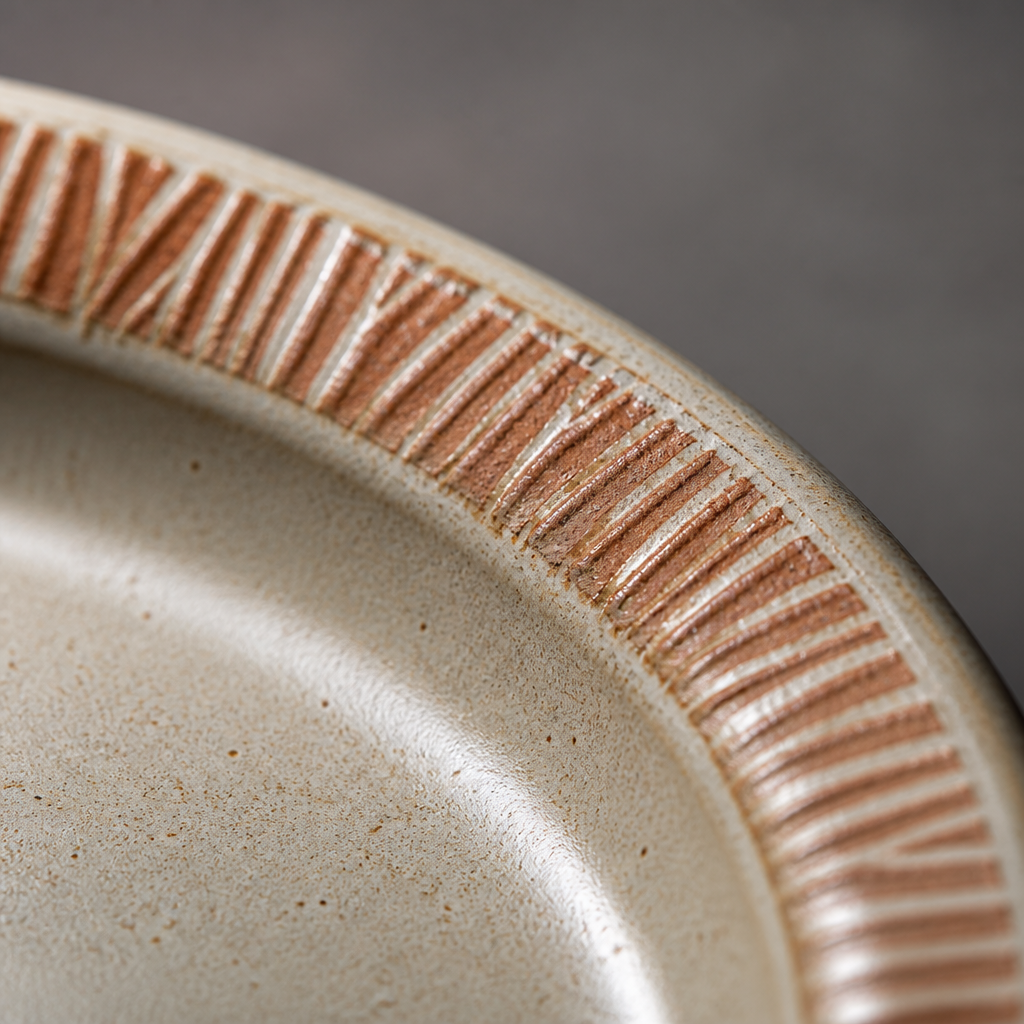
Failures cluster around decoration rather than the clay body. Reactive glazes, hand-applied finishes and on-glaze decals introduce variability, and rims - the zone that meets the mouth - frequently return the highest readings. Batch-to-batch variation in glaze chemistry is the usual cause, which is why lead and cadmium testing on a trial piece says little about volume production. Ceramic tableware compliance failures are process failures. Packing compounds them, because mixed containers and repacking break the link between the tested batch and the article in the warehouse.
Writing Compliance Into the Order
Ceramic tableware compliance holds together when it is written into commercial documents rather than discussed in meetings. Make this evidence a condition of payment to the ceramic tableware manufacturer.
Each line shifts risk to the ceramic tableware manufacturer that controls the process. Lead and cadmium testing costs far less than a refused container, and a change-notification clause prevents a silent glaze substitution. Ask a ceramic tableware manufacturer to sign that list before quotation, because an oem ceramic supplier or porcelain dinnerware factory that hesitates over documentation will also hesitate over a claim.
Keep those records for the life of the product, not the life of the order. A buyer who can produce migration results from several years back answers a regulator with a document, while one who kept only the current season's certificate has to re-test. That archive is the cheapest part of ceramic tableware compliance, and it is the part most often skipped as a programme scales up, because a porcelain dinnerware factory under volume pressure stops filing what nobody asks for.
FAQ
Do I need a new test report for every order? Not always, but you need a defensible link between the report and the batch you receive. When glaze, decoration or firing conditions change, a porcelain dinnerware factory should tell you, and lead and cadmium testing should be repeated.
Is a supplier certificate enough? No. BSCI, LFGB, ISO 9001 and ISO 45001 describe systems. They strengthen a ceramic tableware compliance file but do not replace batch-level migration results, so an oem ceramic supplier should keep the two separate.
What if a result sits just under the limit? Treat proximity as a signal. Ask a porcelain dinnerware factory to explain variation across the batch, then consider tightening the glaze specification. Lead and cadmium testing on a suspect batch rarely settles what matters, which is how the next batch behaves.
Getting a Specification Reviewed
Send the product list, destination markets and decoration plans to [email protected] or call +86-13534638099. The team, as a ceramic tableware manufacturer, maps each item to its vessel category and confirms which lead and cadmium testing applies before quotation. Ranges are listed on the products page.
Chaozhou Qianyue Ceramics, a ceramic tableware manufacturer since 1984, has supplied ceramic tableware from two factories running more than 12 production lines, holding BSCI, LFGB, (EC) No 1935/2004, ISO 9001 and ISO 45001 certification and producing lead-free, cadmium-free ware that is microwave and dishwasher safe. That gives a buyer a documented starting point for ceramic tableware compliance rather than a claim, and it makes the dinnerware range easier to specify for Europe and America at once, whichever oem ceramic supplier supplies the balance of the programme.
 EN
EN