Your brand deserves more than a blank plate. Whether you are launching a café line, expanding a retail assortment, or building a hospitality brand, custom ceramics turn everyday tableware into a statement — your color, your shape, your logo, your story.
The opportunity is real: the global ceramic tableware market is projected to reach USD 18.82 billion in 2025 and grow at a 6.21% CAGR to USD 26.13 billion by 2030 (Mordor Intelligence, 2025). Brands that differentiate through design — not just price — are the ones capturing that growth.
But ordering custom ceramics from a factory 5,000 miles away can feel risky. How do you explain your vision? What should a sample cost? What certifications actually matter? This guide walks you through the entire journey — from first email to delivered container — so you can order with confidence.
Three reasons brands invest in custom ceramic tableware:
Send the factory your product type (dinnerware, mugs, bakeware, etc.), target market, reference images, and quantities. The more context you give — who buys it, where it will be sold, at what price point — the better the factory can recommend materials and finishes.
What to prepare before first contact:
Your two most important decisions happen here.
Body material:
Glaze & finish:
Qianyue tip: a qualified factory should offer multiple body and glaze options and recommend what suits your target market — not just sell you what they already make.
Beyond standard shapes, experienced factories can develop fully custom molds for unique silhouettes — square plates, oval platters, irregular bowls, or specialty items like pet bowls and candle jars. Discuss:
This is where your brand shows up:
Rule of thumb: the more complex the decoration, the more important a pre-production sample becomes.
Never skip this step. A reliable factory produces samples (and often a counter-sample if your design needs adjustment) before mass production. Review:
Many factories charge a small sample fee, refundable or deductible from the bulk order — clarify this upfront.
After sample approval, production typically proceeds through: bulk production → inline inspection → final quality control → export packaging → shipment.
What a professional factory should offer:
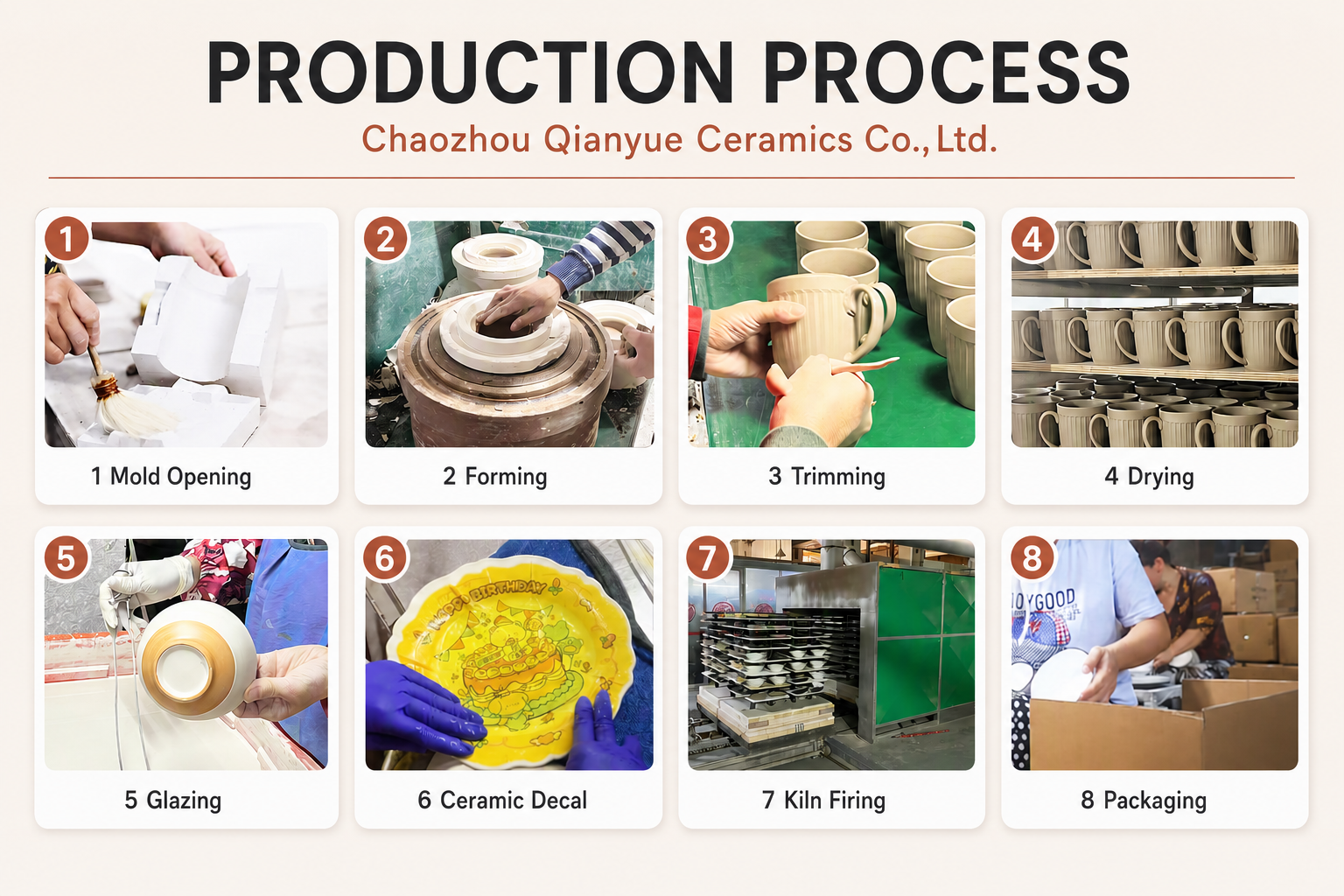
If your products touch food, compliance is not optional — it is a market-entry requirement.
Always ask the factory for: certificates, test reports, and a written guarantee of lead- and cadmium-free materials, plus microwave and dishwasher safety if your market needs it.
There is no universal answer — every factory differs — but here is what to discuss transparently:
A trustworthy factory gives you one clear quotation and one honest timeline, and communicates proactively when anything changes.
Before signing anything, evaluate the factory on five criteria:
What is the difference between OEM and ODM? OEM means we manufacture to your design and specifications; ODM means we design and develop products (shape, glaze, branding) for you, drawing on our own design and development capabilities.
What is the minimum order quantity (MOQ)? MOQ depends on the product and decoration complexity. Tell us your target quantity and we will confirm what is feasible.
Can I get a sample before mass production? Yes. Sampling is a standard step in our process — we recommend it for every custom project, especially with logo decoration.
Do you provide food-safety certifications? Yes. Our factory holds BSCI, LFGB, (EC) No 1935/2004, ISO 9001, and ISO 45001 certifications, and our products are lead- and cadmium-free, microwave- and dishwasher-safe.
Can you match my brand color? Yes — custom color and glaze matching is part of our standard OEM/ODM service.
How long does production take? Lead time depends on mold development, sampling, and order volume. We provide a written timeline with milestones when you place your inquiry.
Since 1984, Chaozhou Qianyue Ceramics has helped brands across Europe, North America, South America, Oceania, Asia, and the Middle East turn ideas into tableware — with over 40 years of OEM/ODM experience, 2 factories, and an annual production capacity of 8 million sets.
We will walk you through every step — from your first sketch to the final container — with transparent communication and after-sales support.
Get a quote today — tell us your product, quantity, and target market, and we will respond with a clear roadmap and quotation.
? [email protected] | ☎️ +86-13534638099 | ? https://www.qyceramics.com/
Sources: Market size figures from Mordor Intelligence, Ceramic Tableware Market Report (June 2025). Company facts from Qianyue Ceramics official website.
 EN
EN